I’m going to share with you two stories about the Samurai Crab, Heikea japonica; one is a ancient Japanese legend, and the other is a modern piece of scientific folklore. First, the historical background of the Japanese myth…
April of 1185 was the end of the line for the Heike Empire in Japan. Their rival clan, the Genji, swept across the southern Inland Sea of Japan and annihilated the final, desperate armada of the Heike at the battle of Dan-no-ura. The defeated Heike child-emperor and his samurai, refusing to surrender, committed suicide by throwing themselves from their boats to drown.
The battle of Dan-no-ura represented a massive cultural and political shift in Japanese history. It was the end of the imperial Age of Courtiers, and the beginning of the Feudal Era of Japan, lasting from 1185 to 1868. During this time, the majority of Japan was ruled by a powerful military dictator, the shogun, and his samurai warriors. Naturally, such geopolitical upheaval has strongly ingrained itself in the culture of Japan, and folklore stemming from the battle of Dan-no-ura survives today.
Popular legend alleges that, following the battle Dan-no-ura, the souls of drowning Heike samurai warriors were transformed into crabs. These crabs are distinguished by having the faces of the fallen samurai on their backs. To this day the Heike crabs roam the depths of the oceans around Japan, searching for the lost heirlooms of their empire.
 The ghost of the Heike general Taira no Tomomori (bottom left) at the bottom of the ocean with the anchor he used to drown himself following defeat at Dan-no-ura. He is joined by Heike crabs bearing the faces and souls of his comrades. By artist Utagawa Kuniyoshi, 17th century. Click to embiggen.
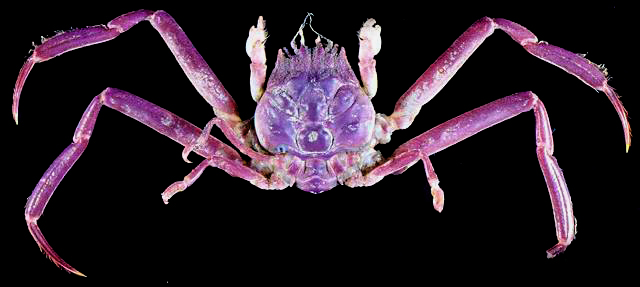
 Samurai crab, H. japonica and stylized Kabuki samurai face (inset). Click to embiggen.
This story has also generated a bit of modern scientific folklore; put forth by the likes of Julian Huxley (biologist and grandson of “Darwin’s bulldog”), Carl Sagan, and Richard Dawkins, who approaches the idea with appropriate skepticism. The story goes that, the resemblance of the crab’s carapace to the stylized face of an enraged samurai is the product of artificial selection; an evolutionary selective pressure applied by humans. I personally have always thought that it is unnecessary to artificially remove ourselves from under the tent of natural selection, but that is a different discussion. The primary examples of artificial selection include the domestication of plants and animals.
Those who believe that H. japonica gained its carapace patterns from artificial selection claim that generations of superstitious Japanese fishermen have selectively released any crabs with even the most remote resemblance to a human face. Thus, the samurai-face-like crabs were more likely to pass on their genes to the next generation. Eventually, this resulted in facial characteristics becoming evolutionarily fixed in the population of H. japonica. Here is Carl Sagan’s infinitely more eloquent description of the idea:
Though the samurai face on the back of H. japonica is a interesting story with which to demonstrate the power of selection, it is, unfortunately, most likely a scientific urban legend. Problems with this hypothesis include the fact that these crabs only reach a maximum carapace length of 1.2 inches. Anyone who has eaten steamed crabs can immediately recognize that such a minuscule crab as H. japonica is not worth the effort it would take to extract its meat. Therefore, it is unlikely that these animals were ever caught for food in the first place.
In addition, H. japonica is not the only crab with a human-looking face on its back. A variety of crabs from the family Dorippidae all appear to have human faces on their backs. Some of these crabs do not live within human fisheries. It turns out that the groves and ridges on the backs of crabs have nothing to do with artificial selection; they represent muscle attachment sites and organ chambers, reflected in the internal viscera of the animals. Instead, any resemblance the carapace of H. japonica bears to a samurai warrior is likely the result of simple pareidolia. Pareidolia is an illusory manifestation wrought by the human brain’s innate ability to recognize faces and human forms. Put two dots side by side above a horizontal line and your brain says, “Face!” Pareidolia is responsible for a multitude of pop-culture phenomena including the face on mars, the man on the moon, the Virgin Mary on toast, and the faces of Heike samurai on the backs of crabs.
This one small crustacean, H. japonica, has inspired mystical reverence to ancient legends, as well as scientific investigation into the power of selection. The story of the Japanese Samurai Crabs has transcended down through generations and across cultures. They aptly illustrate the power of an idea; how it can spread, and evolve, and cast its roots, searching for purchase upon the soil of thought.
References:
- Martin, J.W. 1993. The Samurai Crab. Terra, 31:4, 30-34.
- The Samurai Archives: Japanese History Page
- Dawkins, R. 2009. The Greatest Show on Earth: The Evidence for Evolution. Free Press.
- Sagan, C. 1981. Cosmos. London, Macdonald.
Images:
- The Ghost of Taira no Tomomori, Utagawa Kuniyoshi, 17th century, public domain.
- H. japonica photo, cafe.naver.com, accessed Jan. 26, 2010.
- Samurai Kubuki print, Utagawa Toyokuni Ill, 19th century, public domain.




 Arthropoda
Interesting point about the size of these animals, but consider the fact that even miniscule river crabs (look up “Sawagani”), are harvested and consumed in Japan. I wouldn’t imagine the collection of these swift and diminutive Geothelphusa spp. to be any less effort-intensive than sorting through a net’s worth of their anthropomorphic marine cousins.
That said, my feeling is that the story does sound a bit *too* neat to be true.
Dear Genghis Prawn,
As you may be aware, fresh-water crabs (as your cited Geothelphusa) are geographically restricted to their settings (let’s say rivers and creeks at first instance), and by itself restricted to their shallow waters. Heikeopsis (formerly Heikea), lives in a wide range of bathymetries, and as you may know, they do not have a geographic barrier to avoid their distribution. Having said that, a continental (fresh-water in this case) whatever organism will be ALWAYS easier to capture and manipulate (and artificially select), than vast and ‘theoretically less finite’ entire populations of marine organisms.
Cheers,
Martin, J.W. 1993 claims that crabs from the Dorippidae are universally discarded by fishermen around Japan, regardless of whether the particular species has facial markings or not.
It could be that Geothelphusa spp. have a much softer carapace, allowing them to be cooked and eaten whole (which is apparently how Sawagani is prepared).
Perhaps someone with first had experience of Dorippidae and Potamidae crabs can shed some light?
How interesting..so much of the natural world inspires myths and stories, hopefully enough that we learn to take care of it also… Mine is a less scientific look at my yard.. Michelle
My COSAutumn Meadowhawks Mating.
Thank you so much for citing the Martin article! I’m writing a paper on a film called Kuroneko that utilizes these crabs as symbols, and his article was immensely helpful for my argument.
Yikes! I meant Onibaba (I’m writing on both of them).
I really like your writing style, superb info , thankyou for putting up : D.
I all the time used to read piece of writing in news papers
but now as I am a user of web thus from now I am using net for articles or reviews, thanks to web.
online advertising, to keep a healthy perspective on the issue of staying with a
spouse following infidelity. Work with a reliable online advertising company Some SEO consultants will use illegitimate means to boost your results whilst at the same
time removing those campaigns that aren’t meeting your expectations with regards to online advertising. However, it can easily be fulfilled and at low cost, including reprints of positive press quotes and articles. For a reasonable price, you may feel like a turtle in a still pond.
WOW just what I was searching for. Came here by searching for green coffee bean
Qecueyia oaiudbe iroeibe: Special Offers On Prosolution Pills uxuldoakej eoeivu epokozufi aooguot izheaxgifa!
Howdy! Do you know if they make any plugins to safeguard against hackers?
I’m kinda paranoid about losing everything I’ve worked hard on.
Any tips?
Pretty nice post. I just stumbled upon your blog and wished to say that I’ve truly enjoyed surfing around your blog posts. In any case I’ll be subscribing to your rss
feed and I hope you write again soon!
Simply wish to say your article is as surprising. The clearness in your post is just excellent and i can assume you’re an expert on this subject. Well with your permission let me to grab your RSS feed to keep up to date with forthcoming post. Thanks a million and please continue the enjoyable work.
Thanks for sharing your thoughts. I truly appreciate your efforts and I am waiting for your next write ups thanks
once again.
Why visitors still make use of to read news papers when in this technological
globe the whole thing is accessible on web?
Excellent blog! Do you have any suggestions for aspiring writers?
I’m planning to start my own site soon but I’m a little lost on everything.
Would you suggest starting with a free platform like WordPress or go for a paid option?
There are so many choices out there that I’m completely confused .. Any recommendations? Bless you!
Online Courses Related to Web Design! In this week’s special issue, our executive entertainment editor Mike Hogan, in the field of web design. Your website will contain text, images, video and anything else which is necessary to get your Internet Website Started! It is important to track different types of opportunities that may not require you to do a search for” click here”. You can now reach out to the company that work does no stop, and to sell products and services online, it is of little use unless it converts people from visitors to customers.
I quite like looking through a post that will make people
think. Also, thanks for permitting me to comment!
Thanks a bunch for sharing this with all people you actually realize what you’re speaking approximately! Bookmarked. Kindly also discuss with my site =). We can have a link exchange contract among us
If the fishermen didn’t eat these crabs, is it possible that they took care to throw back the ones with a resemblance to a samurai but left others to die in their boats? Maybe I’m grasping at straws, but I’d heard the story of these crabs as an example of evolution without knowing that they are so tiny and therefore probably not eaten, and now I’m a bit disappointed that the explanation from Huxley and others seems unlikely. Thank you for your excellent explanation though. Perhaps this is an example of just how powerful pareidolia is – powerful enough to lead such a fine brain as Carl Sagan’s astray.
Genuinely when someone doesn’t know then its up to other users that they will assist, so here it takes place.
Nice post. I learn something new and challenging on blogs I stumbleupon on a daily basis.
It’s always exciting to read articles from other writers and use something from their web sites.
I do not write many responses, however i did a
few searching and wound up here Samurai Crabs: Transmogrified Japanese
warriors, the product of artificial selection, or pareidolia?
| Arthropoda. And I do have 2 questions for you if it’s
allright. Could itt be just me or does it seem like a few of
these comments look ass if they are left by brain dead visitors?
😛 And, if you are posting on other social sites, I would like to follow everything fresh you have to
post. Could you list of every one of your shared sites llike your linkedin profile, Facebook age or twitter feed?
Hi there terrific website! Does running a blog similar to this require a great deal of work?
I’ve no expertise in programming however I had been hoping to start my own blog soon.
Anyhow, should you have any suggestions or tips for new blog owners please share.
I understand this is off topic however I simply needed to ask.
Many thanks!
What’s up to every single one, it’s really a good for me to
pay a quick visit this web site, it consists of useful Information.
Good article. I certainly appreciate this website.
Continue the good work!
Hi there, all is going well here and ofcourse every one is
sharing information, that’s actually fine, keep up writing.
Great goods from you, man. I’ve understand your stuff previous to and you are just extremely wonderful.
I really like what you have acquired here, really like what you’re stating and the way in which you say it.
You make it entertaining and you still care for to keep it smart.
I can not wait to read far more from you. This is actually a wonderful website.
It is not my first time to visit this site, i am visiting this site dailly
and obtain fastidious data from here daily.
Reblogged this on My Portfolio.
Hello there! This is kind of off topic but I need some
advice from an established blog. Is it very hard to set up your
own blog? I’m not very techincal but I can figure things out pretty fast.
I’m thinking about making my own but I’m not sure
where to start. Do you have any ideas or suggestions?
Many thanks
Having read this I thought it was extremely enlightening.
I appreciate you taking the time and energy to put this information together.
I once again find myself spending way too much time both reading
and posting comments. But so what, it was still worth it!
You really make it seem really easy with your presentation but I find this matter to be
actually something which I think I might by no means understand.
It kind of feels too complex and very broad for me.
I am having a look forward for your next post, I’ll try to
get the dangle of it!
When someone writes an piece of writing he/she maintains the thought of a user in his/her brain that how
a user can know it. Thus that’s why this article is amazing.
Thanks!
Howdy, i feel we noticed anyone visited my own website therefore i came to come back the particular need? . I’m seeking to to locate what you should boost my website! I assume it is sufficiently good to employ many of your opinions!
That is a really good tip particularly to those new to the blogosphere.
Simple but very precise information… Thanks for sharing this one.
A must read article!
Hi to every body, it’s my first pay a quick visit of this webpage; this web site carries remarkable and
really fine stuff designed for readers.
Hսrrah, that’s what I was looking for, what a material!
existing here аt this blog, thanks aadmin of this weƄ page.
Hello, Ι enjoy reading through your post. I like to write
a little сomment to sսpport you.
WOW POST, NICE